


The Phonemies® (Speech Sound Monsters®) show the speech sound value of any graphemes you don't yet know! Learn the English sounds with Miss Emma!
Show the Code: Which letters are the graphemes, and what is their sound value?
Phonemies® make the phonemes visible, so children can see how the sounds in a spoken word map to the graphemes in the written word.


The Story Peg People from The Reading Hut enable children to act out the stories as they read.
“If they don’t already know the word, they cannot decode it without Phonemies® (Speech Sound Monsters®). If they know the word, they may use partial decoding and Set for Variability to work it out. If they don’t know the word, however, they cannot determine how to decode or pronounce it unless it is mapped using Phonemies®: phonetic symbols for kids.”


Gallimaufry /ɡælɪmɔːfri:/ is a noun meaning a confused mixture, jumble or collection of unrelated things. It originally referred to a stew made from a mixture of different ingredients. Phonemes: /ɡ æ l ɪ m ɔː f r i:/ Graphemes: ‹g› ‹a› ‹ll› ‹i› ‹m› ‹au› ‹f› ‹r› ‹y›
A dog says ‘woof’, a cow says ‘moo’, and the Speech Sound Monsters® (Phonemies®) say...
Phonemies® are used within Speech Sound Play (pre-phonics).

Dys-Code® is a project designed to develop and evaluate an innovative approach to identifying children who may be at increased risk of dyslexia at age three, before they are taught to read.
Designed to include non-speaking children and children who speak little or no English, Dys-Code® aims to identify risk earlier, build a clearer understanding of individual strengths and needs, and enable appropriate support before children have to struggle at school. Earlier identification. Earlier understanding. Earlier support. First Ripple SEND Support from The Upstream Team!
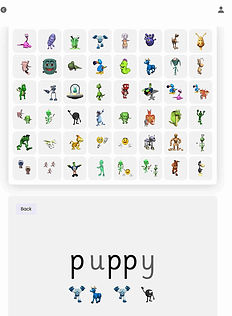
What are Phonemies®? aka Speech Sound Monsters®
Phonemies® are phonetic symbols for kids. Each Phonemie® represents a speech sound only. As with IPA phonetic symbols, Phonemies® (originally known as Speech Sound Monsters® and introduced to children through the Speech Sound Pics (SSP) Approach in Australia) have no fixed relationship with a letter or grapheme when used on their own. The connection with print is made only when a Phonemie® is shown within a mapped word, where it identifies the sound value of the grapheme in that specific word. This means children aren't learning that a particular symbol “goes with” a particular letter. They are using Phonemies® to see and hear how speech and print connect within words. Anyone can use Phonemies®, regardless of the phonics programme or approach being used.
When learning phonics children will be explicitly taught that <e> represents this sound, and maybe a couple of others, but not <a> as in any, or <ai> as in said.
Download and print the words so that children can SEE how he sounds and letters connect in words that children will use daily.




We can’t explicitly teach the whole alphabetic code. If you don’t know it, MyWordz® shows it.
MyWordz® is the only technology that shows which letters form the graphemes and their sound values, using Phonemies® as phonetic symbols for kids.
Pre-school aged children master hundreds of 'sight words' this way, as it makes sense to their brains. They can SEE how letters and sounds connect. Show words with Phonemies first, then as Code Mapped words.
"Follow the Monster Sounds to say the word!

Use the Phonemies® if you don’t know the sound value of a grapheme when reading, or the grapheme for a sound when writing new words! Use MyWordz® technology to SHOW the CODE!


If they don't yet know the Monster Sounds and you don't have MyWordz.tech, use the Monster Spelling Piano app ‘Phonemies®’ screen.
Click the Speech Sound Monster® to hear its sound.
💷 One-time price: £14.95
📲 Download on iPad (Apple):
https://apps.apple.com/gb/app/monster-spelling-piano/id6717616998📲 Download on Android (Google Play):
https://play.google.com/store/apps/details?id=com.edcode.msp

🏫 Schools: 50% discount available via Apple School Manager (for 20+ orders).


Children learn the ‘Monster Sounds’ during the 10-Day Speech Sound Plan in Reception, or at their own pace in the early years. They do NOT need to know them all before mapping words. Use the Phonemies® screen in MyWordz.tech, the app, or the Monster Spelling Piano app.
With and without music
With IPA Phonetic Symbols

MyWordz® Word Mapping Technology

-
Code Mapping® → shows which letters are graphemes.
-
Monster Mapping® → also shows their sound values using Phonemies®.
Pricing Options -
💻 Web Version: £75 per year (introductory offer)
-
Create your account at https://MyWordz.tech
This includes full access to MySpeekie®
You can manage licences and add app access within your account for £5.75 per device
Log in using your MyWordz® account to activate
📱 App Version: £134.95 one-time purchase -
App Store: https://apps.apple.com/us/app/mywordz-with-myspeekie/id6737770129
-
Google Play: https://play.google.com/store/apps/details?id=com.thereadinghut.mywordz


The words one and once will always be red.
For standard British English:
one = /wʌn/
once = /wʌns/
If you're entering them into MySpeekie® using Phonemies®, that would be:
w ʌ n → one
w ʌ n s → once
This is why they're shown in red. The spelling doesn't reflect the graphemes we would expect from those phonemes. No other words use <o> to represent those sounds in this way.
We have a story about this for the children that centres on the Naughty Speech Sound Frog! 🐸
one


Two other things we know you are going to ask about when you start mapping!
The 'swallowed schwa' and the split digraph aka the 'Sound Pic Sandwich'


