


The Language of Word Mapping, Self-Teaching and Orthographic Mapping Theory.
The Language of Word Mapping Mastery
This is an adapted glossary from https://www.speediereadies.com/the-language-of-word-mapping
Blending
Combining individual phonemes together to say a word.
Code Mapping®
Showing which letters in a word go together as graphemes, showing how spelling connects to speech sounds.
Code Mapping® Algorithm
The algorithm that Shows the Code by displaying graphemes within words and texts, including split digraphs.
Decoding
Going from print to speech. The learner sees a written word and works out how to say it.
Duck Hands®
A hand action used to segment spoken words into phonemes and blend them together from left to right.
Dyslexia
A neurodevelopmental difference that affects how efficiently phonemes are mapped to graphemes and stored for automatic use. It is not a visual problem.
Dyslexia Paradox
The contradiction that dyslexia is often identified only after children have experienced repeated failure, even though the brain is most plastic in the early years.
Encoding
Going from speech to print. The learner hears or says a word and works out how to spell it.
English Code Overlay
A visual overlay that makes graphemes and their sound values visible, reducing cognitive load and supporting word mapping.
Grapheme
A letter or group of letters used to represent a phoneme in writing.
Homophone
A word that sounds the same as another word but has a different meaning and usually a different spelling.
IPA
The International Phonetic Alphabet. A universal system for writing down speech sounds using symbols.
Monster Mapping®
Connecting Speech Sound Pics® and Phonemies® to map words.
Opaque Orthography
A writing system where sounds are not spelled the same way every time, and letters do not always represent the same sound.
Orthographic Interference
When the visual appearance of a word interferes with access to its sound structure.
Orthographic Knowledge
Knowledge of how words are spelled and structured in print, and how spelling represents speech sounds in English.
Orthographic Lexicon
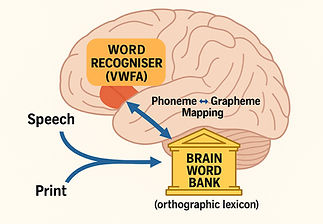
The brain’s stored word bank, where known written words are stored for instant recognition and spelling retrieval.
Orthographic Mapping
The process of bonding speech sounds, spelling and meaning so that words become securely stored in the orthographic lexicon.
Phoneme
The smallest unit of sound in spoken language.
Phonemic Awareness
The ability to hear, identify and manipulate phonemes in spoken words.
Phonemies®
IPA-aligned Speech Sound characters that make phonemes visible and usable for children.
Phonetic Symbol
A symbol used to represent a specific speech sound.
Phonics
The relationship between phonemes and graphemes, and the instructional support used to help children connect them when reading and spelling.
Phonological Working Memory
The ability to hold and manipulate multiple speech sounds in the mind for a short time.
Print-to-Speech Mapping
Mapping from written graphemes to spoken phonemes when reading.
Received Pronunciation
An accent of spoken English traditionally used in teaching materials, dictionaries and audio models in England.
Red Words
Words that are either not yet in the MyWordz dataset. Only one and once are described as the only true red words that won't be mapped to show phonemes and graphemes.
Schwa
The most common vowel sound in spoken English, represented by /ə/.
Segmenting
Breaking a spoken word into its individual phonemes.
Self-Teaching
The process by which children gradually learn new written words independently, without being directly taught each one.
Set for Variability
The ability to adjust a decoded pronunciation when the first attempt does not match a known spoken word.
Speech Sound Mapping
Figuring out words by blending speech sounds, and building words using speech sounds, with a focus on phonemic awareness and phonological working memory.
Speech Sound Mapping is named in an increasing number of EHCPs (England) as an approach to tackling bidirectional word mapping.
Speech Sound Pic® Sandwich
A visual way to show split vowel digraphs.
Speech Sound Pics®
A child-friendly term for graphemes: the written spellings that represent speech sounds in words.
The Speech Sound Pics (SSP) Approach is the only self-paced systematic phonics programme used in a whole-class setting, to ensure that children master the core code before moving into Year 1
Speech-to-Print Mapping
Mapping from spoken phonemes to written graphemes when spelling.
Speedy Paired Decoding
A paired Code Mapping activity used to support decoding within the Speech Sound Pics (SSP) Approach.
Spelling Clouds
Visual displays showing the graphemes that can represent a phoneme.
Statistical Learning
The brain’s ability to notice patterns across repeated word encounters.
Swallowed Schwa
A schwa that is present in the spoken form but does not have its own corresponding grapheme in the written word.
The Code Overlay
A way of showing and stabilising the speech-print connection so decoding and encoding become possible, repeatable and learnable.
The Pronunciation Code
A shared way of understanding the speech sounds being mapped to graphemes, including English, phonics and personal pronunciation codes.
Word Mapping
Bonding speech sounds, spelling and meaning in the brain’s word bank as a route to self-teaching.
Word Mapping Mastery®
Used interchangeably with orthographic mapping, the goal of self-teaching. It describes the process of building secure connections between speech, print and meaning so that words become permanently stored for automatic reading and spelling.
Word Sightedness
Recognition of known words by sight because they have been mapped and stored, not memorised as visual shapes.