


MySpeekie®
Thought to Voice Training
MySpeekie®, the first one-screen AAC with phonetic keyboard for kids, was initially developed with Innovate UK support to help non-speaking autistic children communicate through speech-print mapping. It is being used across the Word Mapping Mastery® system.
Express an Interest in the Next Intake
Women in Innovation Awards 2026
Emma Hartnell-Baker will receive 12 months of support to develop MySpeekie through Innovate UK.


Thought to Voice: Fliss and the Phonemies

Training for AAC Specialists
Around 1 in 10 children start school with speech, language and communication needs (SLCN), rising to more than 50% in some disadvantaged communities.
Speech Sound Mapping supports children from birth by helping them process speech sounds, build phonemic awareness, and connect speech sounds with meaning and print. Rather than treating speech, communication, reading and spelling as separate challenges, it shows young brains how they are connected. This same approach powers MySpeekie®, the world's first one-screen AAC, allowing non-speaking children to communicate using the same speech-print mapping that underpins literacy.

MySpeekie®
The world's first one-screen AAC.
MySpeekie® allows children to generate the exact words they want to say from speech sounds, even if they can't yet read or spell.
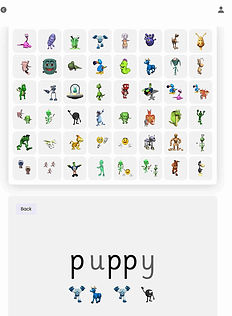
Instead of searching through grids, symbols, categories or pre-programmed vocabulary, children use the Phonemies® (speech sound) keyboard. The words they want to say appear on screen and are voiced instantly.
Originally developed for non-speaking autistic children, MySpeekie® is also being used to support children with speech and language needs, children with unclear speech, and children learning English as an additional language.
MySpeekie® is powered by the MyWordz® speech-to-print mapping algorithm, which makes the structure of spoken words visible. This means children can communicate using the sounds they know, rather than relying on memorised symbols or stored vocabulary.
Why MySpeekie®?
-
World's first one-screen AAC
-
No grids
-
No symbols
-
No pre-programmed vocabulary
-
Generate novel words and sentences
-
Supports communication from the start
-
Built around speech sounds
-
Supports speech and language development
-
Supports English language acquisition
Every child deserves to be understood.

Build a Word Bank of your child's favourite words. They will use it to type the Phonemies® (Speech Sound Monsters) in sequence so that the word appears on screen and can be voiced.
Use the MyWordz® technology to create the words, then download and print them for everyday use.
Very quickly, children learn the speech sound sequence and no longer need the cards!
Speech Sound Mapping leads to earlier and easier reading and spelling because it builds on phoneme–grapheme mapping and helps children connect speech, print and meaning.
Educators who value personalised, child-centred learning, rich oral language, reading for pleasure, hands-on multisensory experiences and having fun will love exploring speech sounds and Speech Sound Pics® with Phonemies®, helping children connect speech, print and meaning in ways that are engaging, purposeful and memorable.
You can Show the Code to children who do not speak English as a first language! MySpeekie®,, the world's first one-screen AAC, has so many uses!

This SSP Monsters Chart shows the commonly used graphemes (Sound Pics) for the main Phomemies. Phonemies are Speech Sound Monsters and all say a sound of English.
Welcome to the Phonemies Family!
FUN Phonetic Symbols for Children.
Also used within the Speech Sound Pics (SSP) Approach in Australia .
Why We Built MySpeekie®
MySpeekie® was Innovate UK Funded. The same principles that help children connect speech and print for reading and spelling can also help non-speaking children communicate.
Many of the children we work with are toddlers, autistic, non-speaking, or have significant speech and language difficulties. We found that communication was often the biggest barrier of all.
Traditional AAC systems can be life-changing, but many rely on children navigating multiple screens, selecting symbols, recognising words, remembering where vocabulary is stored, or learning systems that can be difficult for very young children to understand.
I found that when little children have to learn about print before they can get their words voiced, it can be a long time of feeling frustrated when they're not understood.
So I flipped it.
MySpeekie®, developed with Innovate UK support, is the world's first one-screen AAC for non-speaking children who cannot yet read or spell.
Instead of searching through grids and multiple pages, children type speech sounds using Phonemies®. The words appear on screen and are voiced immediately. This means they can communicate anything they want from the start.
A child can generate messages such as "snack please" or "orange squash in a yellow cup please" without needing to learn to read and spell first.
What surprised us was what happened next.
As children used speech sounds to generate words, they began noticing how speech and print connect. They were not only communicating, they were beginning to discover the structure of written language without explicit, systematic phonics instruction, simply because they were generating the code.
Children generated the words they wanted voiced, but could also see the mapping because MyWordz® uses a word mapping algorithm that handles bidirectional word mapping. When we showed the code so that children could type the speech sounds in the correct order, we were also building strong phonemic awareness. They did not need to focus on the pictures of the speech sounds, the graphemes, until they were ready.
When children are taught to read, the process typically happens the other way round. They are first shown graphemes, if being taught phonics, or whole words, as still often happens with "sight words", and then have to identify the speech sounds and blend them, or remember the word. There is generally a structured progression, with children only being taught certain grapheme-phoneme correspondences when they reach a particular point in a programme. For example, children are not usually taught split digraphs in week one.
With MySpeekie®, children start with the speech. They can generate words containing split digraphs and any other grapheme-phoneme correspondences because they are not restricted by a Scope and Sequence.
If these observations are confirmed through future research, they may have implications that extend far beyond AAC. They raise important questions about how orthographic knowledge develops when children are shown the code and are able to explore bidirectional word mapping from the start. By making the speech-to-print code visible when children are toddlers, we may be able to accelerate self-teaching, particularly for children who struggle with traditional print-to-speech approaches, and potentially prevent literacy difficulties before they occur.
We have also found that this appears to positively impact phoneme articulation. Parents frequently report that their child's articulation and interest in words differ markedly from siblings who did not use the system. Families for whom English is not the first language have also reported that their children develop clearer English pronunciation.
This system may not only be empowering for non-speaking children by allowing them to communicate exactly what they want to say through MySpeekie®. It may also help us understand how to send the majority of children to school already reading, even before they can hold a pencil, simply by integrating speech-to-print mapping into everyday interactions at home and in nursery. Children can use the technology to record speech, develop phonemic awareness and explore the code, even when the adults around them are unaware of the importance of these underlying skills. A stand-alone training course launches shortly.
We have also found that generating text from speech sounds helps adults better understand English orthography. They become more aware of how the code works and why at least 1 in 5 children currently struggle to learn to read and spell.
To understand why this may be significant, we first need to understand why so many children struggle to learn to read and spell in English.
Express an Interest in Specialist Training

We Show the Code™ across all of our courses, showing which letters are graphemes and their sound values using Phonemies® (Phonetic Symbols for Kids). This is the foundation of reading and spelling and helps unlock self-teaching.
With the exception of MySpeekie®, where the primary purpose is AAC and communication, the core purpose of our courses is the same: to help every child start self-teaching reading and spelling as quickly and easily as possible.
How we achieve that will look very different depending on the child, their stage of development, what they already know and the context in which they are learning.
That might mean working with a toddler who already has strong phonemic awareness, supporting 25 children working at different stages in a Reception classroom, helping a child with an EHCP who has struggled with synthetic phonics, or supporting an older child with dyslexia who is unable to keep up with age-related reading and spelling demands.
The destination is the same: children who have developed the word-mapping skills they need to become self-teaching readers and spellers, so that they can work out unfamiliar words, check their mapping when they need to, and retain new words for future reading and spelling.
We want every child to reach that point as quickly and easily as possible, with as much explicit instruction as they need, and no more.