


MyWordz® Word Mapping Technology shows you how the speech sounds in any spoken word connect with the letters used to spell it. Use it to read, spell or teach any word.

Learn to use MyWordz®
The Phonemies® show the sound value (phoneme) of the letters (graphemes) in any word. Phonemies® show the phonemes!
_edited.jpg)


Education departments expect phonics teachers to know how to map words in both directions. But what guidance do they receive?
Emma Hartnell-Baker MEd SEN has been supporting teachers to map words bidirectionally for over a decade. Bidirectional Word Mapping is at the heart of her Speech Sound Pics (SSP) Approach, developed in Australia. This self-paced Structured Linguistic Phonics (SLP) approach covers the Core Code in Reception, following the Ten Day Speech Sound Play Plan, which introduces reading and spelling speech-to-print with a focus on developing good phonemic awareness. The Core Code is then explored in both directions.
Print to speech (reading): MyWordz® shows which letters form the graphemes in a written word and the phoneme represented by each grapheme.
Speech to print (spelling): MyWordz® with MySpeekie® shows how the phonemes in a spoken word map to graphemes, revealing the word's spelling.
Phonemies® (Speech Sound Monsters®) make the phonemes visible, and users can toggle between Phonemies® and the International Phonetic Alphabet (IPA) to see the sound values.
You can learn more about Bidirectional Word Mapping at WordMappingFormula.com. The purpose of this site is to demonstrate the many ways MyWordz® technology can be used to support learners, educators and families.
Bidirectional Word Mapping with MyWordz® Technology: SHOW the Code!
Instant Visual and Auditory Access to the English Pronunciation, Reading and Spelling Code for ALL Words, including words with grapheme-to-phoneme correspondences (GPCs) not taught in a phonics programme, e.g. machine, England or language.
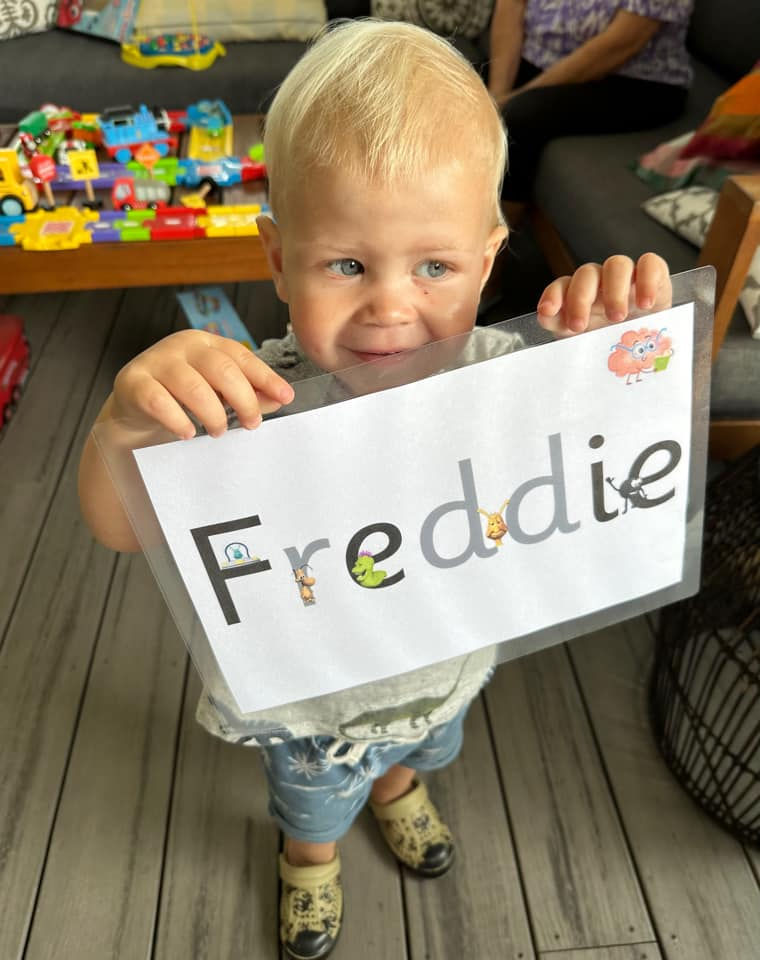
MyWordz® technology instantly shows which letters are graphemes and their sound values, with Phonemies®, so children can access the code they need, in the word they need, when they need it, even if they are toddlers! Phonemies® do NOT LINK WITH LETTERS until there is a word! Don’t Make Them Wait. If They Don’t Know It, Show It!
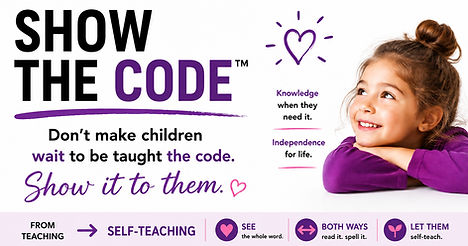
Show the Code
Instant Visual and Auditory Access to the English Pronunciation, Reading and Spelling Code for ALL Words. MyWordz® technology offers the first English Pronunciation Guide. During Show the Code™ training, we show you the numerous ways you can use it.
Show the Code News & Freebies!

For the first time, you'll know exactly how to help a child figure out unfamiliar words and QUICKLY learn to spell new ones, whatever the word and regardless of their existing phonics knowledge. Children love to be able to INSTANTLY see how speech and print connect.
MyWordz® word mapping technology helps you see exactly how speech and print connect, so you can provide the right reading and spelling support to each child in the moment.
You can also map ANY word, so they can figure it out themselves. Children LOVE being able to figure out words independently!

MyWordz® Word Mapping Technology

-
Code Mapping® → shows which letters are graphemes.
-
Monster Mapping® → also shows their sound values using Phonemies®.
Pricing Options -
💻 Web Version: £75 per year (introductory offer)
-
Create your account at https://MyWordz.tech
This includes full access to MySpeekie®
You can manage licences and add app access within your account for £5.75 per device
Log in using your MyWordz® account to activate
📱 App Version: £134.95 one-time purchase -
App Store: https://apps.apple.com/us/app/mywordz-with-myspeekie/id6737770129
-
Google Play: https://play.google.com/store/apps/details?id=com.thereadinghut.mywordz
Support reading and spelling in the way children enjoy and understand. No more spelling rules, silent letters, syllable division or other outdated pedagogy. The science has moved on. It's time phonics teaching did too. Word Mapping technology changes everything!




Teaching Spelling?
Instead of reaching for a one-size-fits-all programme with word lists to work through, consider Structured Linguistic Spelling (SLS), a self-paced approach to orthographic learning. You’re still doing what’s expected, word mapping and analysis, but using words the child can’t currently spell or decode when reading.
So, the words each child needs, when they need them, rather than having the whole class work through words that some children may have known for years. Some are bored; some aren’t ready.
You can do this without using a programme. All grades. Personalised learning.
No memorisation of whole words. No taught ‘rules’.
The main investment is you – knowing what is expected when supporting this.
“To spell a word, pupils should identify the phonemes in the spoken word and write the graphemes that represent them.”
The Writing Framework Department for Education, England, 2025, p. 41
Emma Hartnell-Baker MEd SEN
Advocate for Self-Paced Orthographic Learning (SPOL) SPOL to SPELL! ♡
Structured Linguistic Spelling

Phonemies show the English speech sounds. They are phonetic symbols that even toddlers understand.


"As much explicit instruction as they need, and no more." Show the Code: Join the Guided Self-Teaching (GST) Movement
Use MyWordz® to Immediately Show What So Many Children Find Difficult
English pronunciation, spelling and the connection between speech and print are INSTANTLY made visible.
Emma Hartnell-Baker MEd SEN developed MyWordz®, powered by the Ortho-GraphiX® bidirectional word-mapping algorithm, so anyone can look up an English word and see how it’s pronounced, which letters represent which sounds, and how those sounds map back to the correct spelling.
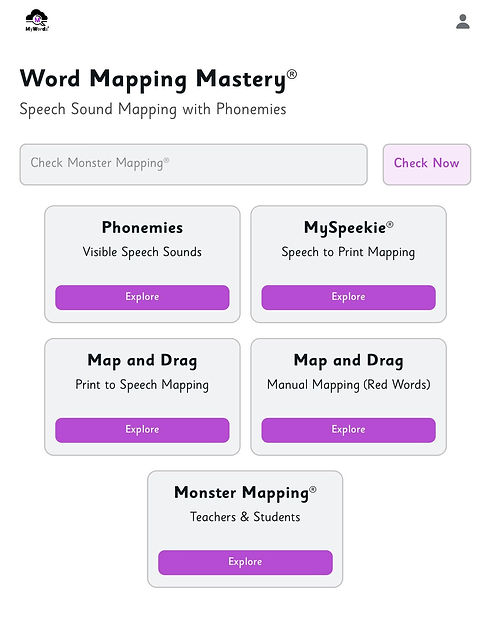
Want to know how an unfamiliar word is pronounced? Use Check Mapping.
Want to spell a word? Say it into Check Mapping, or type the sounds using the MySpeekie® feature and the Phonemies® phonetic keyboard. MyWordz® gives you the correctly spelt word AND shows you the mapping.
Want to know which letters represent which sounds? Use Check the Mapping.
Want to communicate but can’t say the word? Use MySpeekie®.
Want to download and print mapped words? Use Map and Drag.
Want to Code Map® large pieces of text, or add your own words if they’re not yet in the MyWordz® Word Bank? Use Map and Drag Red Words.
The English Pronunciation Guide is a straightforward way for anyone to see how English pronunciation and spelling connect, with MyWordz® as the technology doing the work.
This means learners don’t have to rely on an adult having extensive training in phonics, linguistics, phonetics or morphology to get the information they need. And they can access that information whether an adult is there or not.
During Show the Code™ training, we’ll train you in the numerous ways you can use MyWordz® technology. But the technology will always Show the Code™ for the learner, in whatever way they need it, in the moment.
No waiting for the next lesson. No waiting until a correspondence has been taught. No dependence on an adult knowing the answer. Show the Code™. In the moment.

We show you how to map ALL words, so you can stop trying to explain English spelling and pronunciation
"Independent learning is made possible, not by better programmes but by better experiences"
Emma Hartnell-Baker
By making the complete bidirectional code visible, you are supporting the orthographic mapping and self-teaching processes that enable ALL children to move confidently between speech and print, store words in memory, and become independent readers and spellers.

Children in Reception are able to see which letters represent phonemes when words are mapped, and we can now do this automatically using word code mapping technology. We can, and should, Show the Code to map words in both directions: print to speech for reading, and speech to print for writing.
“The goal isn’t to teach as much about as many properties of print and language as time allows, appropriating more of the school day to get it all done. Rather, it is to enable the child to start acquiring the relevant knowledge as they engage in reading, writing, and spoken language activities.”
(Seidenberg, 2026)
Despite generations of educational theory and billions spent, around 1 in 4 children still fail to reach expected literacy levels after seven years in school, including in England where explicit, systematic phonics is mandated. For too long, parents and educators have been expected to explain how words are spelt and pronounced in English. For the first time, an alternative is available: every word of English can be mapped so that the code can be shown, not explained, and easily understood in the early years.
Learn how to map words bidirectionally and use MyWordz® technology throughout the day with our FREE support and training.

Those selling dyslexic fonts often ignore the reality of what dyslexia is and can perpetuate the myth that it’s primarily a visual problem.
Code-mapped text, however, was designed with the research in mind.
We make all text decodable through our Show the Code approach, supporting the statistical learning needed to facilitate orthographic mapping.
Children can choose a Code Mapped® view that simply highlights which letters work together as graphemes. A free Lite version is available on here They can also add Phonemies®, our child-friendly phonetic symbols, which show the sound value of each grapheme.
Our Show the Code™ Speech Sound Mapping training is on this STC site, focusing on bidirectional word mapping.
It’s not a programme. Use the technology every day, at the point of need.
If you’re supporting children at risk of reading and spelling difficulties, you can guide self-teaching from speech to print and from print to speech.
Less teaching. More guided self-teaching.
Show the Code!


Show the Code™ with MyWordz®
When we Show the Code™ we are making the hidden code of English visible for all words, at the moment of need. By showing which letters work together as graphemes and what sounds they represent, children can read words they haven't seen before, spell words they want to write, and understand how spoken words connect to print.
Rather than being given isolated pieces of code and expected to work out the rest, children can see the complete code within words. This allows the brain to detect patterns, build connections, and store words more efficiently through orthographic mapping and statistical learning.
As children repeatedly see which letters are graphemes, and their sound value in words, which can be adapted for accents, they begin to recognise these patterns for themselves. The goal is not to teach any rules or strategies. The goal is for children to understand how speech maps to print so that the brain can store words and discover patterns naturally.
Learn to use the tech, so that you can guide your child or student to mastery the word mapping code for themselves.
By making the complete bidirectional code visible, we can (for the first time in history) show the code for every word, regardless of accent. This uniquely supports the orthographic mapping and self-teaching processes that enable children to move confidently between speech and print, store words in memory, and become independent readers and spellers.
It's time to stop saying children have learning differences or 'special needs' because they struggle with one-size-fits-all programmes. What if we decided to change the system instead? Join us. Not Reading Reform. Phonics Reform.
For a child to become a confident reader and speller, they need to understand how speech sounds (phonemes) and graphemes connect in both directions, what the words mean and be reading and writing as much as possible. If you want to support that process, you need to be confident with bidirectional word mapping. Stop asking children to "sound it out" (if they could, they would), or trying to explain written English. Just Show the Code. Understand why some can read, but struggle with spelling. Guided self-teaching makes orthographic word mapping far easier.

This 60-second Spelling Routine strengthens phonemic awareness and bonds speech sounds, graphemes and meaning for instant word recognition and accurate spelling when writing. As words become securely stored in the orthographic lexicon, learners develop an internal reference for how words look. This means they are more likely to recognise when a word they have written does not look right and can self-correct without relying on memorisation or guessing. Map, download and print words using MyWordz® technology.

Spelling Simplified: Show the Code. Yet anther use for the MySpeekie® Phonetic Keyboard!

The benefit of telling them the word if they can't (yet) decode it, or writing the word when they can't yet spell it!
You can do this with any child, at any age or stage.
Remember, most of the correspondences they get stuck on may be correspondences they may never cover in the Core Code during explicit phonics lessons anyway.
#ShowTheCode
MyWordz®: Thought to Voice | Show the Code Technology
We developed Thought-to-Voice Technology with Innovate UK funding. MySpeekie® is the world's first one-screen AAC, designed for children who are non-speaking, use few words, or whose speech is difficult for others to understand. It requires no speech, reading or spelling to use, while supporting children to communicate, learn to read and learn to spell. The MyWordz® word-bank already contains over 20K words!

Phonemies (Speech Sound Monsters): Phonetic Symbols for Kids


Word Mapping Mastery® Book Coming Soon:
WordMappingMastery.com
Phonics Reform England (PRE) PhonicsReformEngland.com
Facebook SpeechSoundPics
Email Support@WordMapppingMastery.com
Learn more about orthographic word mapping so you can meet the needs of your individual child or students.
Show the Code is not a phonics programme or intervention. This word mapping training is designed to deepen your understanding of how words are mapped between speech and print for both reading and spelling, helping you make informed decisions about the support, teaching approaches and resources you use with individual learners. You will learn how to guide self-teaching of the reading and spelling code by supporting bidirectional word mapping at the time of need.

The Reading Hut® Ltd is the home of the Word Mapping Mastery® ecosystem, an integrated collection of educational approaches, publishing, assessment, professional development and technology designed to help children become confident, independent communicators, readers and spellers.
Our philosophy is simple. We want every learner to become a confident, independent communicator, reader and speller who reads for pleasure. We therefore provide as much explicit instruction and support as each learner needs, and no more, helping every learner develop the confidence and independence to continue learning through successful communication, reading and writing.